 Australia & NZ
 中国
中国 India
India Indonesia
 日本
日本 한국
한국 Malaysia
 Philippines
 Singapore
 台灣
台灣 ประเทศไทย
 Tiếng Việt
Solvent-based cleaner vs Water-based cleaner
Cleaning agents are used in a wide variety of environments, ranging from manufacturing sites, such as automobile and food factories, to service industry settings, including restaurants and hotels.
Cleaning agents can be broadly classified into solvent-based cleaners and water-based cleaners, but what are the differences between these two types?
In this article, we will explain how each type works, along with its respective advantages and disadvantages.
Solvent-Based Cleaners
Solvent-based cleaners, as the name suggests, are cleaning agents that use solvents as their main component. The properties of solvent-based cleaners vary depending on the type of solvent used. For example, aerosol-type parts cleaners, which are widely used for their ease of application, typically contain alcohols such as ethanol or petroleum-based substances such as hexane as solvent ingredients.
These components are effective at removing grease, oil, and other types of dirt that are hard to clean with water. But how exactly do they work to break down and remove such contaminants?
This is a slightly more technical, liquids have a property known as polarity.
This depends on the structure of the molecules that make up the liquid. Molecules are composed of various atoms such as carbon, hydrogen, and oxygen. Because different types of atoms have different abilities to attract electrons, the distribution of electrons within a molecule can vary depending on its structure.
In some molecules, electrons are evenly distributed throughout the entire molecule, while in others, the electrons are unevenly distributed, creating areas of partial charge. Molecules with an even electron distribution are described as “non-polar,” whereas molecules with an uneven electron distribution are referred to as “polar.”
Non-polar molecules have a property called lipophilicity (oil affinity), meaning they mix well with oils. In contrast, polar molecules are hydrophilic (water-affine), meaning they mix well with water.
Hexane, a component commonly found in solvent-based cleaners, is a non-polar, lipophilic molecule. This allows it to dissolve and remove oil-based contaminants effectively.
On the other hand, alcohols, which are also used in solvent-based cleaners, have a slightly different characteristic. Their molecular structure contains both hydrophobic (water-repelling) and hydrophilic (water-attracting) parts. This gives alcohols the ability to mix well with both water and oil. You can see this property in everyday life — for example, when drinking alcoholic beverages, alcohol and water do not separate, illustrating their compatibility.
Advantages and Disadvantages of Solvent-Based Cleaners
Solvent-based cleaners offer various advantages and disadvantages. The typical advantages of solvent-based cleaners can be summarized as follows:
- They can quickly remove contaminants.
- They require minimal drying time.
- They are less likely to cause rust.
- Some types are safe for use on electronic equipment.
First, solvent-based cleaners can remove contaminants more quickly compared to water-based cleaners.
For this reason, it is common to see large cans of parts cleaner and plenty of wiping cloths kept on hand at sites where frequent removal of light oil stains is necessary.
Another major advantage is that, although it varies slightly depending on the specific ingredients, solvent-based cleaners tend to evaporate quickly from the surface after use. This means there is no need for thorough wiping.
In contrast, water-based cleaners generally require wiping after application, and depending on the formulation, they can even contribute to rust formation — a concern that does not apply to solvent-based cleaners.
Another unique advantage of solvent-based cleaners is that they can be used to clean electronic equipment, where water-based cleaners cannot be applied.
Although careful selection is required, as some ingredients may affect circuit boards, solvent-based cleaners are ideal for cleaning electronic devices contaminated with substances such as oil mist.
On the other hand, the disadvantages of solvent-based cleaners include the following:
- They are often flammable.
- Storage quantities may be restricted.
- There are concerns about the health effects on workers.
Since solvent-based cleaners are organic substances, they are typically flammable. For this reason, specific highly flammable components are subject to quantity restrictions under fire safety regulations, which may limit how much can be stored in one location.
In addition, while the high volatility of solvent-based cleaners helps reduce working time, it also increases the risk of workers being exposed to solvent vapors.
Furthermore, some solvent-based cleaners contain substances that have been identified as potential carcinogens. As a result, an increasing number of companies are choosing to limit or avoid the use of such cleaners to protect the health of their employees.
Water-Based Cleaners
As the name suggests, water-based cleaners are made from ingredients that dissolve in water.
As explained earlier, oil-based contaminants such as grease and oil do not dissolve in water on their own. Therefore, water-based cleaners use a different mechanism to remove such contaminants compared to solvent-based cleaners.
So, how exactly do water-based cleaners work to remove dirt and oil?
The Role of Surfactants
Water-based cleaners typically contain ingredients called surfactants. While the term may not be familiar to everyone, surfactants are actually the main active ingredients in common products like soap, body wash, and household detergents.
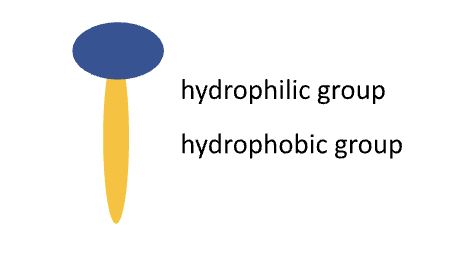
Surfactants have a structure that combines two distinct parts: a hydrophilic (water-attracting) head and a lipophilic (oil-attracting) or hydrophobic (water-repelling) tail, as illustrated below.
The surfactants in the cleaner remove oil-based contaminants through the following process:
1️⃣ The hydrophobic tails of the surfactant molecules feel “uncomfortable” in water, so they are drawn to the oil contaminant and begin to gather around it.
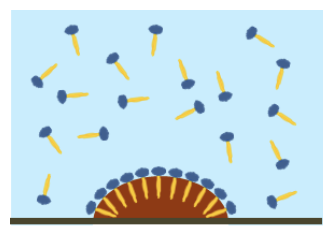
2️⃣ The surfactant molecules surround the oil, lifting it away from the surface. As more surfactant molecules gather, they continue to enclose the oil.

3️⃣ Eventually, the oil becomes completely encased by the surfactant molecules, forming a spherical structure known as a micelle. In this form, the oil is dispersed in the water.

It is worth noting that the effectiveness of this process is greatly influenced by water temperature.
For example, when the temperature is low and fats or oils solidify, the surfactants are unable to disperse the oil contaminants effectively into the water, making it harder to remove the dirt. This is similar to when you try to clean a pot after cooking curry at home — using only cold water and detergent makes it difficult to remove the residue, but using warm water helps. This is because the fats in the curry have solidified at low temperatures.
On the other hand, excessively high temperatures can also negatively affect the action of surfactants. Depending on the type of surfactant, very high temperatures can reduce solubility in water, or the increased molecular motion at high temperatures can interfere with micelle formation.
Therefore, to use water-based cleaners efficiently, it is important to choose the appropriate temperature based on the type of cleaner and the nature of the contaminant.
Advantages and Disadvantages of Water-Based Cleaners
Water-based cleaners also offer various advantages and disadvantages. The general advantages of water-based cleaners include:
- They are non-flammable.
- They can be diluted with water for use.
- They pose relatively lower chemical exposure risks for workers.
Since water-based cleaners use water as their solvent, flammability is not a concern. This makes them safe for use even in environments where open flames or heat sources are present, and there are no storage quantity restrictions under fire safety laws.
Although cleaning power typically increases with higher concentrations, one advantage of water-based cleaners is that they can be diluted with water when high concentrations are not necessary. Even high-performance, more expensive water-based cleaners can contribute significantly to cost savings when properly diluted for appropriate applications.
In addition, unlike solvent-based cleaners, water-based cleaners are not volatile, which helps reduce workers’ exposure to the cleaning agents. With risk assessments regarding health impacts now mandatory in many workplaces, the ability to better control exposure makes water-based cleaners an increasingly attractive option.
On the other hand, the disadvantages of water-based cleaners include:
- They tend to take longer to remove contaminants compared to solvent-based cleaners.
- Additional steps for rinsing and drying are required.
- They can contribute to rust formation.
As we have seen, the cleaning mechanisms of solvent-based and water-based cleaners are different, which is why water-based cleaners generally take longer to remove contaminants.
Since water-based cleaners contain cleaning agents dissolved in water, it is necessary to rinse or wipe off these residues after cleaning. Additionally, any water remaining on metal surfaces, such as iron or steel, can cause rust, so it is important to thoroughly dry the surfaces after cleaning.
While each of these disadvantages can be addressed through various countermeasures, such measures often require new equipment or additional steps in the process. As a result, when switching from solvent-based cleaners to water-based cleaners, it is common for the overall cleaning process to take more time.
Conclusion
In this article, we have outlined the differences between solvent-based cleaners and water-based cleaners. When selecting a cleaning agent, it is essential to understand the advantages and disadvantages of each type and choose the most suitable option based on practicality, safety, and overall effectiveness.
At NCH Asia Pacific, we offer a wide range of cleaning solutions, including solvent-based cleaners, water-based cleaners, and parts cleaning systems designed to minimize splashing. Our experienced industrial maintenance specialists are ready to propose the optimal cleaning solution tailored to your needs.